Stephen Clingman

William Kentridge | Milestones Collection
William Kentridge is a singular force in contemporary art whose remarkable career takes center stage in this richly illustrated and deeply considered volume tracing the ideas and influences that shape his expansive practice. With an essay by longtime friend Stephen Clingman, a conversation with novelist Julian Barnes, and a photo essay by Jabulani Dhlamini, this book offers rare insight into the mind of an artist who makes history flicker, fracture, and come alive. Specially created for the Milestones series, two Tree of Life pieces trace the artist’s inspirations - from Goya to Mayakovsky, Shostakovich to the present day. The volume is not a retrospective; it is an invitation to follow the restless journey of creation itself.
Click image for Italy; here for US

William Kentridge
Liberating Vision and Six Meditations
Catalogue of the Exhibition, William Kentridge, Royal Academy of Arts, London, September 2022
The South African artist William Kentridge is internationally renowned for the expressionism of his work in numerous media. As elusive as it is allusive, his art emerges from the South African environment yet also responds to the aftermaths and echoes of other settings and histories. Grounded in science, literature and varied artistic idioms, it always maintains space for contradiction and uncertainty. In what has been called a brilliant exposition of Kentridge’s work, Stephen Clingman, who wrote the full text of the RA catalogue, undertakes a series of enquiries through the various layers and linkages of Kentridge’s art. Along the way, overlaps, thought-collages, allusions and assemblages come together to create a connective, dimensional way of thinking inspired by Kentridge’s own habits of creation.
Click image for the Royal Academy; here for US.

Bram Fischer
Afrikaner Revolutionary
Co-Winner Sunday Times/Alan Paton Award 1999
In 1964 Bram Fischer led the defence of Nelson Mandela in the Rivonia Trial. In 1966 Fischer was himself sentence to life imprisonment for his political activities against the policies of apartheid. Before his sentencing, he had spent nine months underground, in disguise, evading a nationwide manhunt. He was South Africa’s most wanted man, his cause recognised and celebrated around the world. This meticulously crafted and beautifully written biography follows a fascinating journey of conscience and personal transformation. Weaving the personal and the public, Stephen Clingman provides a magisterial account of tragedy and transcendence, showing how the miracle of South Africa’s transition to democracy was deeply connected to the legacy of Bram Fischer. ‘An outstanding contribution to our understanding of modern South African history.’ Tom Karis ‘An astonishingly good book.’ Peter Alexander ‘Clingman has given his fellow South Africans a slice of history to be proud of.’ Victoria Brittain, The Guardian

Birthmark
Longlisted for the Sunday Times/Alan Paton Award
When Stephen Clingman was two, he underwent an operation to remove a birthmark under his right eye. The operation failed, and the birthmark returned, but in somewhat altered form. In this captivating book, Stephen takes the fact of that mark—its appearance, disappearance and return—as a guiding motif of self and memory in the divided world of apartheid. How, in such circumstances, can we come to a deeper kind of vision, find our place in the midst of turmoil and change? ‘A profound reflection on vision and identity…. I was engrossed, challenged, moved.’ - Ivan Vladislavić ‘Clingman, like J. M. Coetzee, has an exceptional gift for making the most of memoir as genre…. It is a narrative that makes deep tracks in the psyche.’ – Jonathan Amid, Netwerk 24 ‘One can only celebrate the work for its subtle, balanced finish, and for the way it recodes familiar terrain as strange and terribly beautiful.’ – Leon De Kock, Mail and Guardian (Johannesburg)
Click image for US edition; here for South African.
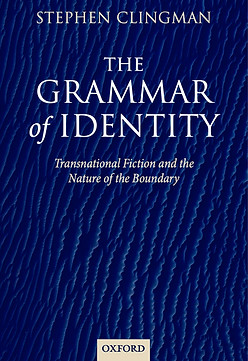
The Grammar of Identity
Transnational Fiction and the Nature of the Boundary
In a world of dizzying forms of multiplicity as well as powerful appeals to singularity in matters of location and identity, how do we negotiate the relation between the two? How do we navigate the boundaries that divide us? Stephen Clingman takes up the idea of a grammar of identity in exploring alternative understandings of self and place in a disparate and uneven world. Discussing the work of some of the major writers of the 20th and 21st centuries, the book offers not only a searching work of literary criticism but also a contemplation for our times. ‘This is that rarity—a work of lucid high complexity…a work that sets one arguing with oneself. It is also an extraordinary work of literature, in itself, achieved with compelling beauty.’ Nadine Gordimer ‘Clingman’s sense of navigation…charts an iconoclastic and illuminating course across the waterways of the world’s Anglophone literature.’ Mark A. McCutcheon, Ariel
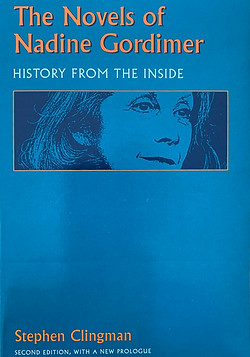
The Novels of Nadine Gordimer
History from the Inside
Hailed on its publication as a turning point in the analysis of South African literature, Stephen’s book was also cited on the Nobel Prize website as ‘the best study’ of Gordimer’s work when she won that award in 1991. The book is an account of historical consciousness in Gordimer’s novels, where ‘history’ is not so much a sense of the past but an urgent exploration of the unfolding present, along with its burdens, obligations, and responsibilities. A study of form as much as of content, the book ends with an account of the ‘deep history’ of Gordimer’s fiction. ‘Remarkable, both for [Clingman’s] brilliant presentation of Gordimer’s ideas and development as a writer.’ Jane Starfield, Weekly Mail (South Africa) ‘A brilliant, subtle, sombre, and precise book… essential reading.’ Landeg White, African Affairs ‘It is a book of tremendous wisdom and should find its way on to the book shelf of any person who thinks seriously about South Africa.’ Isabel Hofmeyr, (Johannesburg) Star ‘The Novels of Nadine Gordimer is the best critical work on the 1991 Nobel prize winner available… [Clingman’s] reading of The Conservationist, perhaps one of Gordimer’s most achieved works, is especially inspired.’ Elleke Boehmer, The Guardian
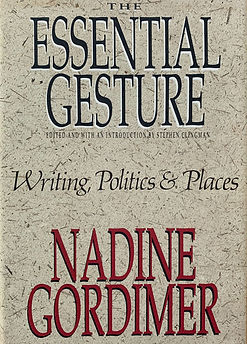
The Essential Gesture
Writing, Politics & Places
Edited and introduced by Stephen Clingman
The Essential Gesture was the first volume of Gordimer’s non-fictional essays to appear, and was translated into a number of languages. Topics range from the autobiographical and biographical, to Gordimer’s remarkable travel pieces from various locations in Africa, to the complexities of writing in South Africa during what Gordimer (following Antonio Gramsci) calls the interregnum—when 'the old is dying and the new cannot be born'. Always Gordimer’s writing shows her unfailing sense of accountability in the context of apartheid. ‘This volume of essays, skillfully selected and introduced by Clingman, is the record of [Gordimer’s] lifelong creative plunge.’ Salman Rushdie, The Observer ‘Her contemporaries…have all written non-fictional work which attempts to grapple with the conundrum of their existence as white South African writers, but none have written with more eloquence or consistency of purpose than Nadine Gordimer.’ Caryl Phillips, The Guardian